


Plankton, the tiniest aquatic creatures that drift around the sea in their trillions and trillions, play the mightiest role in saving lives on the Earth. These unsung heroes of the marine ecosystem are the only life-sustainer for the ocean’s bounty of creatures – from invertebrates and larvas to the mighty whales, almost all aquatic lives feed on plankton. More interestingly, plankton functional variety boosts ecosystem stability and productivity.
It’s no secret that these microscopic organisms play a vital role in tackling the climate crisis by absorbing atmospheric CO2 – the leading greenhouse gas with a massive role in wreaking mayhem on the World’s climate.
But how much CO2 does plankton absorb? Let’s dive deeper.
What Are Plankton?
Stemming from the Greek word ‘planktos’ meaning ‘Drifter,’ planktons are motile or non-motile microorganisms found in both salty and freshwater that drift along with the tidal force.
Most species in the plankton community are prokaryotic or unicellular eukaryotic living organisms that are highly involved at the cellular level. However, you can also find multicellular plankton. Global assessments of prokaryotic pelagic plankton demonstrate a stock of 1029 cells, the biomass of around 2 Pg carbon, and a genetic richness of conceivably up to 2 million various types of taxonomic units.
Though planktonic microbes are minute, they are a community of officially registered 11000 species that unanimously make up 90% of the total mass of aquatic life. No doubt, the plankton community is more diverse, having more types of species in the row to be registered officially.
Biologists estimated that there are less than 1bn tonnes of single-celled green microbes living in the sea at a time. 45bn tonnes of new green plankton get added each year which is 45 times more than their own mass at any given period.
Types of Plankton
Plankton can be categorised based on trophic level, size, shape, drifting time, etc. For example:
Based on the Lifecycle
- Holoplankton: Planktonic (drift along with the tides for their entire life cycle) marine organisms. Example: copepod, jellyfish, krill, diatom, salp, algae, etc.
- Meroplankton: Organisms with both planktonic and benthic phases in their lifecycle. Example: larva stages of sea urchins, crab, starfish, sea squirts, worms, etc.
Based on the Size
- Megaplankton: plankton of over 20cm in size. Example: jellyfish.
- Macroplankton: Plankton of around 1cm in length. Example: crustaceans, sargassum, etc.
- Mesoplankton: Plankton of 0.2 to 20mm living at the middle depths of a sea. Example: ctenophores, amphipods, salps, etc.
- Microplankton: Net plankton that sizes between 0.05 and 1 mm. Example: phagotrophic protists, dinoflagellate, etc.
- Nanoplankton: Plankton cells that are 2–20μm in size. Example: diatom, algae, protists, etc.
- Picoplankton: Fraction of planktonic organisms having cells between 0.2 and 2 μm. Picoplankton can be either prokaryotic or eukaryotic phototrophs, heterotrophs, or autotrophs. Example: chrysophytes, archaea, bacteria, etc.
- Femtoplankton: Planktonic organisms of less than 0.2 µm. Example: aquatic viruses.
Based on the Trophic Level
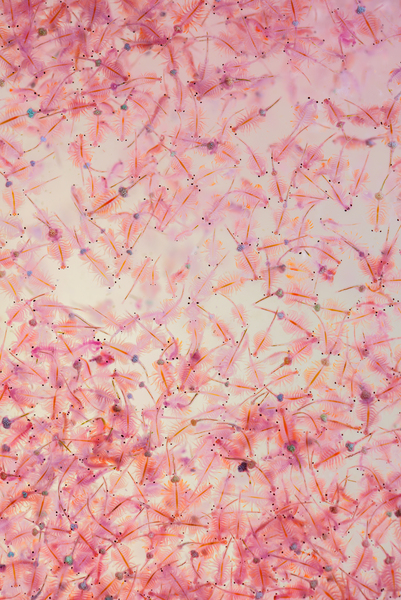
- Phytoplankton: Single-celled photosynthetic phytoplankton with cytophyll. Different types of phytoplankton are green algae, cyanobacteria, coccolithophores, and dinoflagellates.
- Zooplankton: Primary or secondary consumers of the marine ecosystem that graze on phytoplankton (primary consumer) or other zooplankton (secondary consumer). Example: krill, jellyfish, molluscs, conger eel., etc.
- Mycoplankton: the saprotrophic community of plankton and includes filamentous free-living yeats and fungi.
- Bacterioplankton: Free-living autotrophic planktonic organisms under the domains Bacteria and Archaea. Example: green-algae.
- Virioplankton: Phytoplanktonic organisms that include bacteriophages and meagerly, eukaryotic algal viruses.
- Mixotrophs: Photosynthetic plankton capable of phagotrophy. Mixotrophs constitute almost half of the plankton community.
How Much CO2 Does Plankton Absorb
As we have already stated, plankton play a critical role in mitigating climate change and combating global warming by absorbing atmospheric CO2 and trapping them in the deep ocean.
Let’s dig into how the ocean and these oceanic creatures help buffer the terrific carbon emissions resulting from anthropogenic activities.
Phytoplankton, the autotrophic plankton, live in the euphotic sea zone, photosynthesize using chlorophyll and convert sunlight into chemical energy and organic materials as their nutrients. They take up atmospheric Carbon dioxide and release Oxygen as a photosynthetic byproduct during this process.
A part of these green plankton is eaten by zooplankton, aquatic invertebrates, small fishes, and larvae. When they decompose or are eaten by the primary consumers of the ocean ecosystems, the captured Carbon backs into the near-surface sea. But when phytoplankton die, the consumed Carbon dioxide turns into carbon-rich organic compounds known as ‘marine snow’ that sink into the deep sea following the BCP (Biological Carbon Pumping) process.
While a small part of phytoplankton break down chemically and is eaten by aquatic creatures, most are moved to the deep water. Globally, the BCP process moves about 10GT atmospheric carbon to the ocean depths each year. This way, phytoplankton can fix around one-fifth of heat-trapping carbon by helping oceans sequester and lock up CO2 for thousands of years.
However, how successfully phytoplankton can photosynthesize and sequester CO2 depends on how much sunlight can infiltrate the water layers.
For example, diatom, a natural sink of atmospheric Carbon dioxide, can fix around 10-20 billion metric tons of inorganic carbon per year – it is equivalent to the CO2 taken up annually by all the World’s rainforests unanimously! More interestingly, researchers have found out that one acre of algae can strip up to 2.7 tons of CO₂ out of the air each day. Some specific microalgae species can help bury CO2 at a rate of 10-50% higher than terrestrial trees and plants.
Plankton Are Disappearing: The Causes and Effects
Phytoplankton, the swirling tiny marine creatures that gobble CO2 and act as the bedrock of the marine food web, are disappearing by nearly 1% on average per year – their number has dwindled by 40% since 1950. And if we fail to check this trend immediately, it will badly decimate the marine ecosystems and food chains, causing alterations to the equilibrium of nutrient cycling.
Research reveals that around 50-80% of the total Oxygen produced in the World comes from the ocean. And the lion’s share of this O2 is produced by aquatic photosynthesizers like seagrass, seaweed and phytoplankton. For example, the most miniature member of the phytoplankton community, Prochlorococcus, supplies around 20% of the total O2 in the biosphere.
With the drop in the number of plankton, the ocean’s carbon sink will also decline, and in turn, the concentration of atmospheric CO2 will shoot up, followed by a surge in global temperature that will kill even more plankton.
With more than 1000 chemicals getting synthesised each hour, the number of industrial toxins released directly into the sea surges. Unprocessed industrial discharges of toxins like organic mercury and tin, PCBs, oxybenzone, PBDE, etc., accumulate in the seawater. By combining with the plastic toxin (DDT), these contaminants create a condition on the water surface that plants and plankton cannot survive. Plastics block sunlight from penetrating water layers, hinder photosynthesis in phytoplankton, and kill them, causing deoxygenation and suffocation of the sea.
Being a synthesised oily organic compound, plastics cling to plankton and other contaminants. As these pollutant-loaded globules (plastic, plankton, toxins, etc.) are eaten by zooplankton and mammals, toxin concentration increases all the way up the aquatic food web, playing havoc with all marine lives.
Summing up, as we lose plankton, atmospheric O2 concentration will rapidly fall off, and the carbon content in the air will soar, triggering a runaway greenhouse effect.

- Poke Yoke in Manufacturing: Preventing Errors at Their Source - February 6, 2026
- Integrated Payment Systems: Fueling Scientific Advancement Through Efficient Funding - January 12, 2026
- Professional Distribution Center Cleaning Services Explained - December 13, 2025