



Oceans, swarming with a bounty of lives, play a critical role in maintaining the balance of the World’s ecosystems and mitigating climate changes. The driving force comes from phytoplankton, the plant-like microorganisms that live in swirling seawater in their trillions and trillions.
But how do these minute aquatic creatures help tackle the climate crisis and form the base of the marine food web?
Do they have any role in the carbon cycle, or is carbon stored in phytoplankton? Let’s unpack everything essential about these ocean photosynthesizers and how they gobble up atmospheric CO2.
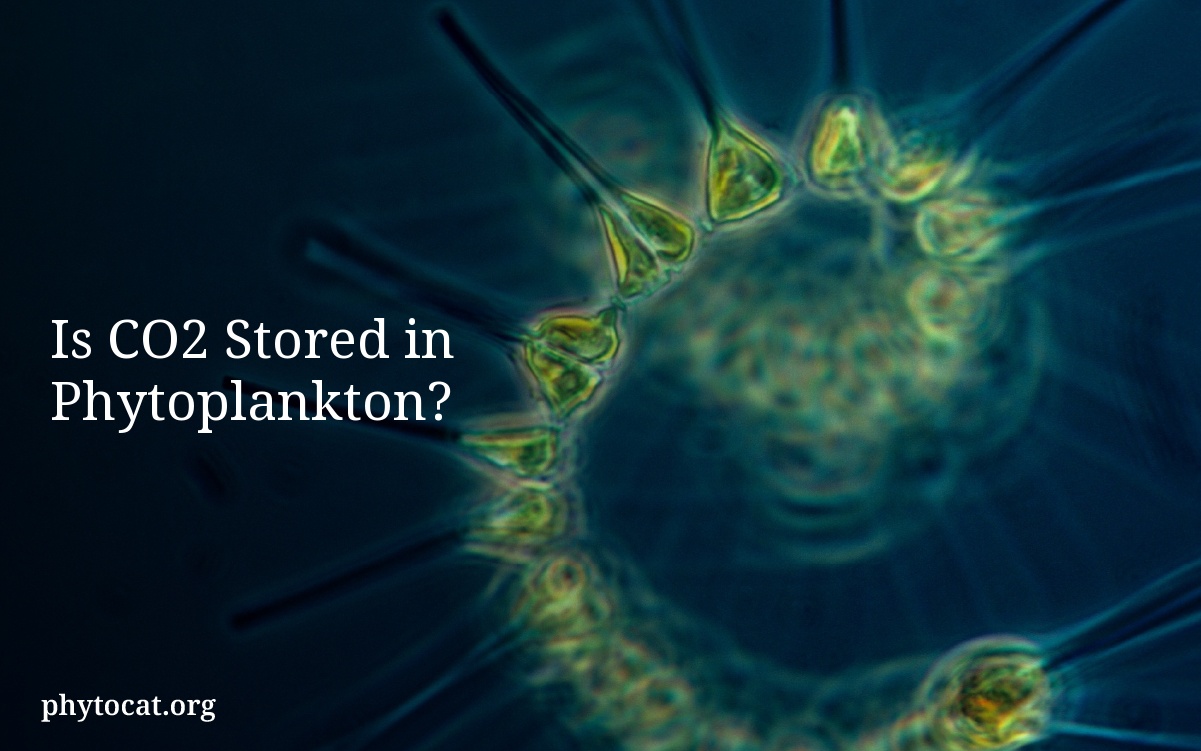
Is Carbon Stored in Phytoplankton?
To be precise, yes, phytoplankton store carbon in their biomass. But how do these small ocean creatures trap atmospheric CO2 – a leading greenhouse gas that can play havoc with the World’s climate? Let’s unpack:
How Do Phytoplankton Absorb CO2?
Phytoplankton are autotrophic and unicellular planktonic organisms that live suspended in seawater and photosynthesise to produce their own food. They take up dissolved CO2 from the seawater and make it react chemically with water to produce glucose and other carbon-based organic compounds in the presence of sunlight and essential nutrients like phosphorus, iron, and Vitamin B. This glucose, through cellular respiration, keeps phytoplankton’s metabolic activities running. Phytoplankton have green pigments (chlorophyll A) to capture the red and blue light radiated by the Sun. This way, through oxygenic photosynthesis in phytoplankton, CO2 reduces into glucose, and water molecules oxidise into oxygen. The oxygen gets freed into the environment as a photosynthetic byproduct.
While a part of the captured CO2 backs to the upper layers once the carbon compounds enter the aquatic food web or break down chemically, a large portion is pulled down to the deep seawater as phytoplankton die, decay, and sink through the water column as ‘marine snow.’ This way, phytoplankton pump around 15% of the total CO2 they assimilate down to sea depths via the BCP/Biological Carbon Pump process – a system that vertically moves photosynthesis-derived organic particles from the near-surface water layers to the deep sea.
How Much CO2 Is Stored in Phytoplankton?
Although these aquatic planktonic microbes constitute only 1-2% of the total biomass, they soak up around 30-50 BMT CO2 each year into their cells through photosynthesis, which gets stimulated by iron via windblown dust. The carbon captured by these pelagic creatures is more than 40% of the total sequestered CO2.
Climatologists have found out that diatom, a group of more than 16000 species (mainly microalgae), sequesters about 10-20 billion tonnes of CO2/year, equivalent to the carbon trapped by all rainforests in a year.
While seagrass, a group of multicellular algae, makes up only 0.2% of the total seabed, it’s a significant carbon stock that holds 10% of the ocean’s total carbon sink.
Role of phytoplankton in Ocean Food Web
Ocean food web is a system of involved and interlinked food chains having phytoplankton at the base. These self-feeding organisms sustain ocean ecosystems providing food to the most aquatic creatures – from Bivalvia to the gigantic whales, all graze on phytoplankton. Besides other factors, the concentration of nutrients like phosphorus, nitrate, calcium, and iron highly influence the number of these primary producers in the sea that the most herbivores (primary consumers), like most zooplankton, protozoa, larvae, etc., live on. These primary consumers, in turn, are preyed upon by carnivores and top-level consumers like corals, baleen whales and big fishes.
How do Phytoplankton Mitigate Climate Change?
Since the Industrial Revolution, the atmospheric CO2 concentration has shot up by 46% and reached 416.5ppm in 2021 (280ppm in 1750). We are presently dumping CO2 into the air at a rate of 1.5ppm/year – a big thanks to anthropogenic activities.
But now, when more countries are trying to go Net Zero by 2050, limiting global warming to well below 2-degree Celsius or preferably 1.5-degree Celcius, the role of this ‘ocean’s invisible forest’ in curbing CO2 emissions is undeniable. They, by consuming CO2 from the upper seawater layers, let oceans dissolve and trap more atmospheric CO2. The biosphere is so dependent on these tiny marine organisms that even a minor drop-off in the phytoplankton population can lead to environmental catastrophe.
BCP accounts for stowing 10GT CO2/year, converting it into organic materials, and locking it away in the deeper sea layers for hundreds to thousands of years. If the phytoplankton population drops, the ocean’s carbon sink will also reduce. It would affect the CO2 concentration in the air, which, in turn, will feed back to the Earth’s temperatures – the more the green plankton can reproduce and populate, the more atmospheric CO2 can settle in the seawater. Scientists say that a 1% increase in the phytoplankton number is equivalent to 2 billion full-grown trees.
Although phytoplankton release a small amount of CO2 with O2 during cellular respiration, they account for supplying more than 50% of the total oxygen in the biosphere. For example, Prochlorococcus, the tiniest member of the phytoplankton community, releases approximately 20% of the total O2 we require.
Long-term Changes in Phytoplankton
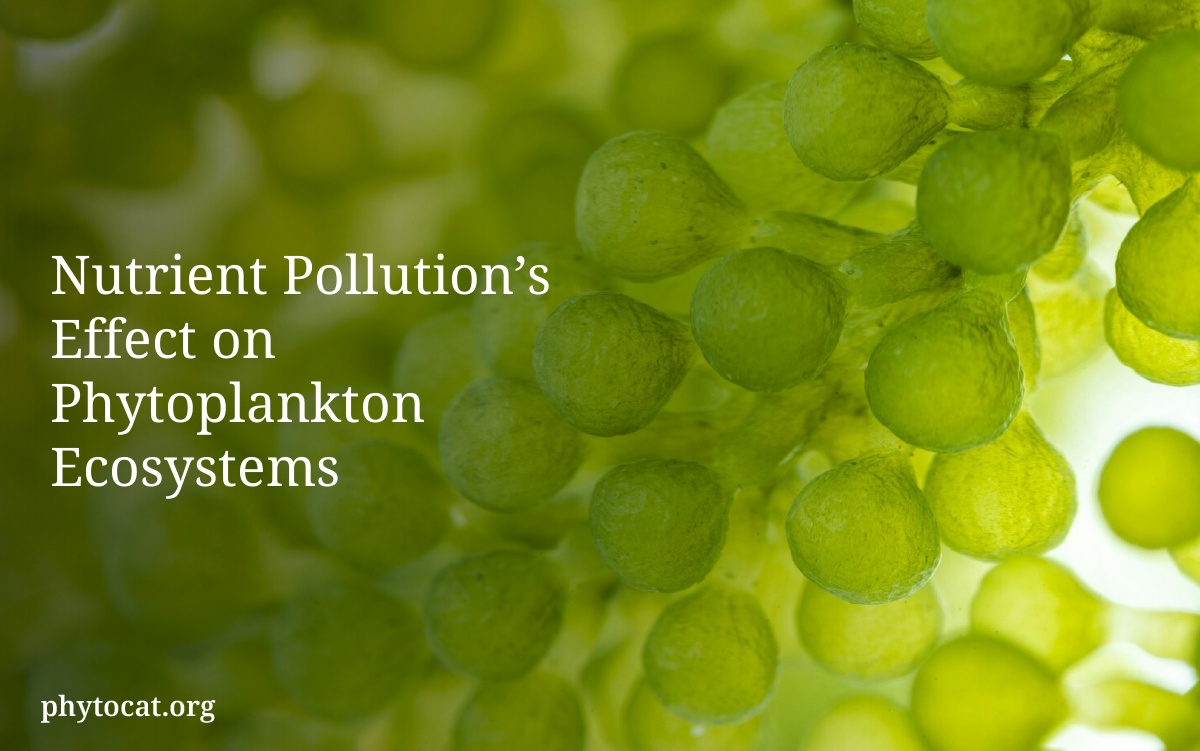
- Productivity: According to studies, upper seawater layers get hotter in response to growing GHG emissions that result in thermal stratification during warm conditions. Such stratification inhibits vertical turbulent mixing that regulates the upwelling of nutrient-rich waters and redistributes salinity and temperature in the seawater. As a consequence, phytoplankton productivity plunges.
- Species Composition: There are 5000+ officially registered species of aquatic phytoplankton adapted to different water quality and environmental variables. Their compositions and development vary with a set of complex factors – ocean pH level, salinity, turbidity in the seawater, dissolved CO2 quantity, and more. As larger planktonic organisms need more macronutrients to reproduce and populate than smaller ones (cyanobacteria), they need the upwelling current to transfer more nutrients. As stratification initiates, it allows phytoplankton to stay on the well-lit near-surface seawater and thus spurs algae bloom. As the blooms thrive, they use up the top-layer nutrients. But with the increase in thermal stratification in the ecosystem, the mixed seawater layer above the nutriline starts shrinking and blocking nutrient replenishment in the topwater, which, in turn, plunges the number of bigger phytoplankton.
Phytoplankton, the swirling aquatic organisms that gobble up atmospheric CO2 and form the base of the marine food web, are declining by nearly 1% on average per year – their number has lowered by 40% since 1950. And if we cannot control this decline rate and take all-inclusive measures to stop the climate crisis immediately, the ocean ecosystems and food webs will be thrown off balance, causing changes to nutrient cycling stability.

- Poke Yoke in Manufacturing: Preventing Errors at Their Source - February 6, 2026
- Integrated Payment Systems: Fueling Scientific Advancement Through Efficient Funding - January 12, 2026
- Professional Distribution Center Cleaning Services Explained - December 13, 2025